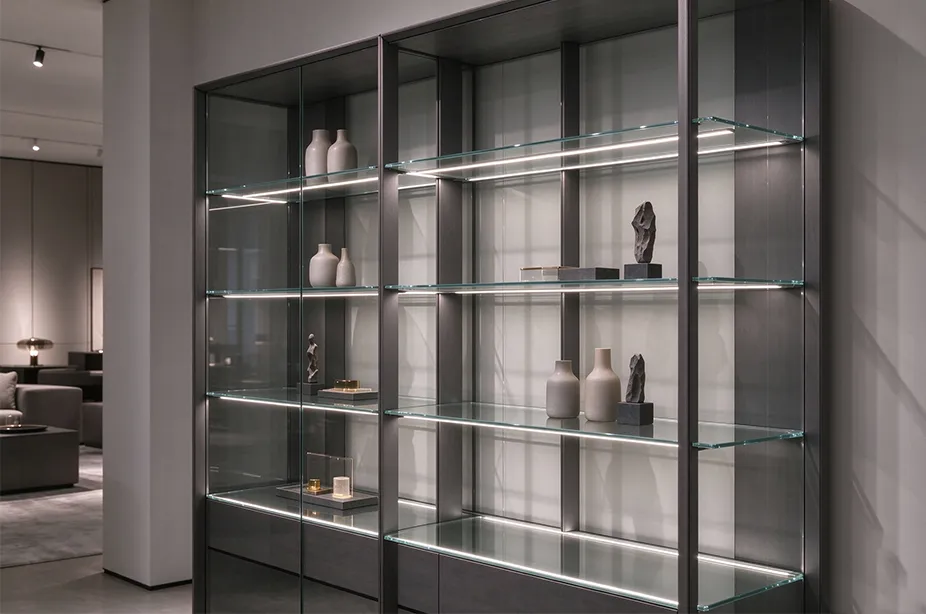
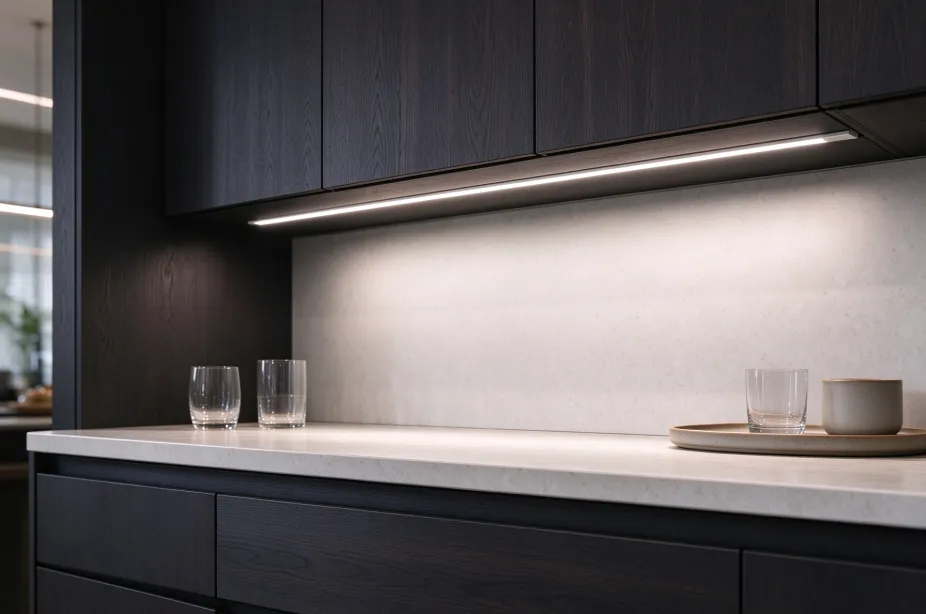
Choosing an LED driver for cabinet lighting starts with matching the driver's output type to the LED fixture. Two common approaches are constant voltage (CV) and constant current (CC). They regulate different electrical characteristics and are designed for different LED loads.
Understanding these differences helps furniture manufacturers select compatible lighting products, plan electrical connections, and avoid driver-related compatibility problems before production.
What Is the Difference Between Constant Voltage and Constant Current?
A constant voltage LED driver maintains a fixed output voltage while supplying current according to the connected load, within its operating limits.
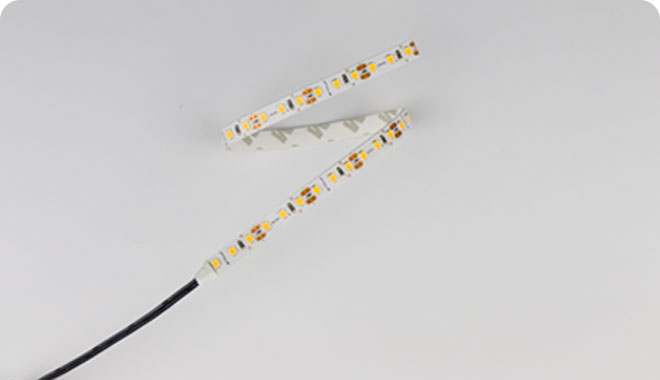
Common low-voltage LED systems use 12V or 24V DC. Many LED strips and furniture lighting products are designed for these fixed-voltage systems.
A constant current LED driver regulates the current supplied to the connected LED load within a specified output voltage range. It is suitable for LED modules designed to operate at a defined current.
The distinction is important because these two driver types are not interchangeable. A fixture designed for a constant-voltage supply should not be connected to an arbitrary constant-current driver, or vice versa.
The correct choice must follow the actual lighting fixture's electrical specifications. Always match the driver's regulated output to the specified voltage or current requirements of the LED module.
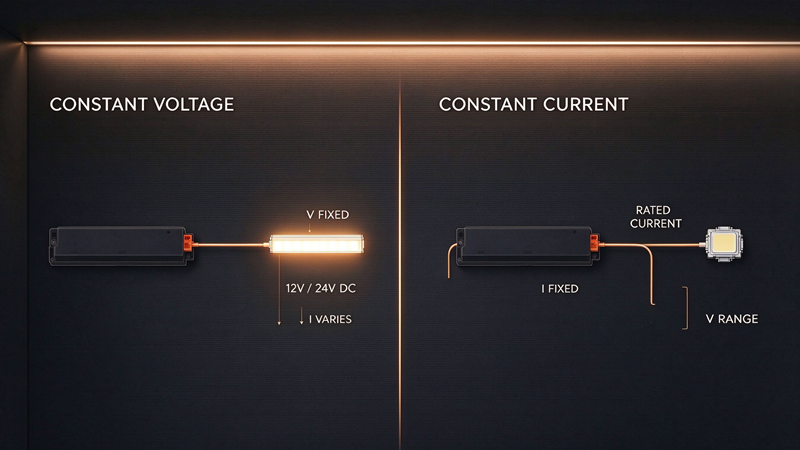
Comparing LED Driver Technologies
The following comparison highlights the key differences between constant-voltage and constant-current LED drivers.
| Factor | Constant Voltage | Constant Current |
|---|
| Regulated output | Voltage | Current |
| Typical specification | 12V or 24V DC | Rated output current |
| Suitable load | Fixed-voltage LED strips and fixtures | Current-driven LED modules |
| Fixture matching | Match rated voltage | Match rated current and voltage range |
| Load planning | Calculate total connected wattage | Confirm rated current and operating voltage range |
| Typical applications | Low-voltage cabinet lighting systems | LED modules designed for constant-current operation |
Neither driver type is inherently more efficient or reliable. Performance depends on the driver design, connected LED load, operating conditions, and electrical configuration.
Manufacturers should check complete fixture and driver specifications before approving a lighting system.
How 12V and 24V Fit into Cabinet Lighting Systems
Many low-voltage cabinet lighting products use fixed-voltage systems such as 12V or 24V DC. These applications commonly use constant-voltage LED drivers designed to match the fixtures' rated operating voltage.
For comparable power loads, a 24V system generally draws less current than a 12V system, which can make certain longer wiring configurations more practical.
However, the correct voltage must always match the LED fixtures and connected control components. Cable length, conductor size, and voltage drop should also be evaluated during system planning.
For a more detailed overview of driver selection, see our guide to How to Choose the Right LED Driver for a Furniture Lighting System.
How to Match Driver Output to LED Lighting Loads
For constant-voltage systems, begin by confirming the rated operating voltage of each LED fixture. Then calculate the combined power consumption of all connected lights and select a driver with sufficient output capacity.
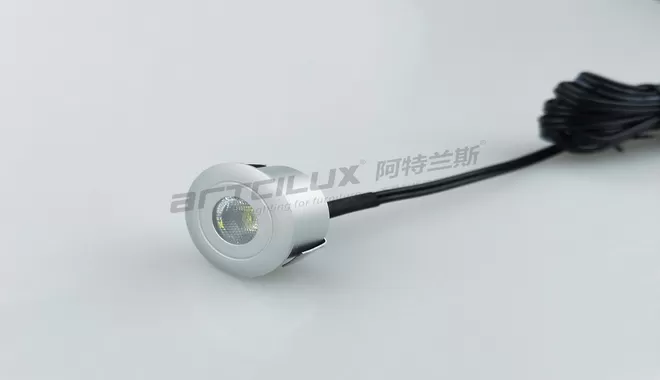
For example, four compatible LED lights rated at 6W each have a combined nominal load of 24W. The selected driver should provide the required output voltage and suitable power capacity according to the manufacturer's recommendations.
For constant-current systems, wattage alone is not enough. The driver's rated output current and operating voltage range must match the LED module's electrical requirements and connection configuration.
Dimming functions introduce additional compatibility requirements. The LED fixture, driver, and dimming controller must support the same control method.
A correctly matched system should be evaluated as a complete assembly rather than by considering the driver's wattage rating alone.
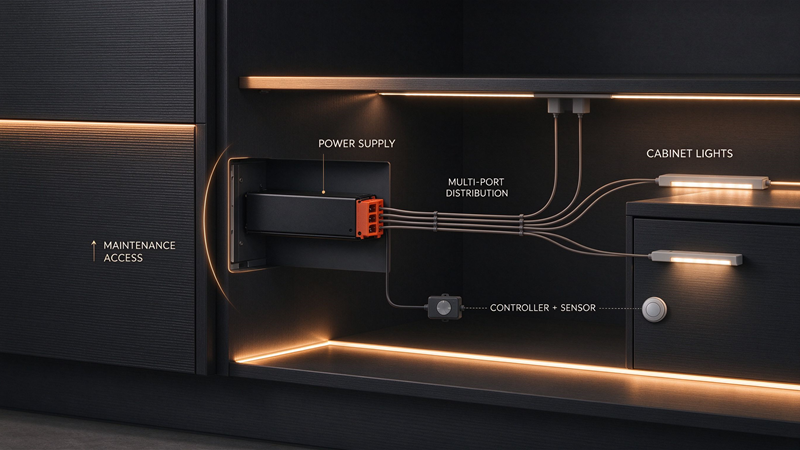
ARTCILUX Power Supply Solutions for Furniture Manufacturers
ARTCILUX provides cabinet power supply products designed for integrated furniture lighting systems.
Its LSD03 ultra-slim power supply series includes two 65W configurations: KA1265LSD03 with 12V DC output and KA2465LSD03 with 24V DC output.
Both models feature a compact 175 × 65 × 15 mm design, AC 220–240V input, and six parallel output connections with an additional high-current terminal.
The product specification sheet also lists protection against overload, overvoltage, overheating, open-circuit, and short-circuit conditions. Its slim design supports concealed installation in furniture structures where available space is limited.
| Specification | KA1265LSD03 | KA2465LSD03 |
|---|
| Product Series | LSD03 Ultra-Slim Power Supply | LSD03 Ultra-Slim Power Supply |
| Output Voltage | 12V DC | 24V DC |
| Input Voltage | AC 220–240V | AC 220–240V |
| Rated Power | 65W | 65W |
| Dimensions | 175 × 65 × 15 mm | 175 × 65 × 15 mm |
| Output Connections | 6 parallel channels + high-current terminals | 6 parallel channels + high-current terminals |
For furniture manufacturers, selecting the power supply alongside the lighting fixtures and control components helps ensure system compatibility during project development.
Explore the ARTCILUX Cabinet Power Supply range or view the LSD03 Ultra-Slim Power Supply for further product information.
ARTCILUX also supports OEM/ODM projects involving labeling, packaging, connectors, cable arrangements, and project-based power supply selection. Manufacturers can submit lighting specifications, installation dimensions, and target-market requirements for product evaluation.
Conclusion
Constant-voltage and constant-current LED drivers serve different electrical requirements. The correct choice depends on the LED fixture's design, rated output requirements, and system configuration.
For furniture manufacturers, confirming driver compatibility before production helps reduce electrical mismatches and improve lighting system reliability. ARTCILUX provides cabinet power supply options and OEM/ODM support for integrated furniture lighting projects.
Frequently Asked Questions
Can a 24V supply power a 12V LED strip?
Not directly. A 12V strip should receive the voltage specified by its manufacturer unless an appropriate conversion system is used.
Does a higher-wattage driver force more power into an LED strip?
A correctly matched constant-voltage supply provides its rated voltage. The connected load determines current draw within the supply's operating limits.
Can a single driver supply several cabinet lights?
Yes, if voltage, total load, distribution connections, and control compatibility are suitable.
Does every LED driver support dimming?
No. Dimming capability and control compatibility depend on the specific model.
Can a constant-current driver power a constant-voltage LED strip?
Not unless the driver and LED strip are specifically designed to work together. Always match the driver's output type to the LED fixture's electrical specifications.
Can ARTCILUX supply customized connectors and cable arrangements?
ARTCILUX describes connector, cable, labeling, and packaging options for OEM projects. Feasibility depends on the selected products.