How to Ensure Consistent LED Color in Cabinet Lighting Projects: CCT, SDCM & LED Binning
For cabinet manufacturers and furniture brands, choosing the right LED color temperature is only the first step in developing a reliable lighting system. Maintaining consistent light appearance across multiple cabinets, production batches, and furniture installations is equally important. Even when two LED strips are labeled 3000K or 4000K, their actual light appearance may differ because of variations in chromaticity, LED binning, and manufacturing tolerances.
These differences can become particularly noticeable in modern kitchens, wardrobes, display cabinets, and other furniture applications where several lighting fixtures operate close together. A slight color mismatch between adjacent light strips can affect the overall appearance of the finished furniture.
For furniture manufacturers, achieving consistent cabinet lighting requires more than specifying a nominal color temperature. It involves controlling correlated color temperature (CCT), color rendering, SDCM, LED binning, and production quality throughout the manufacturing process.
This guide explains the key technical factors behind LED color consistency and provides practical recommendations for specifying and sourcing reliable cabinet lighting systems.

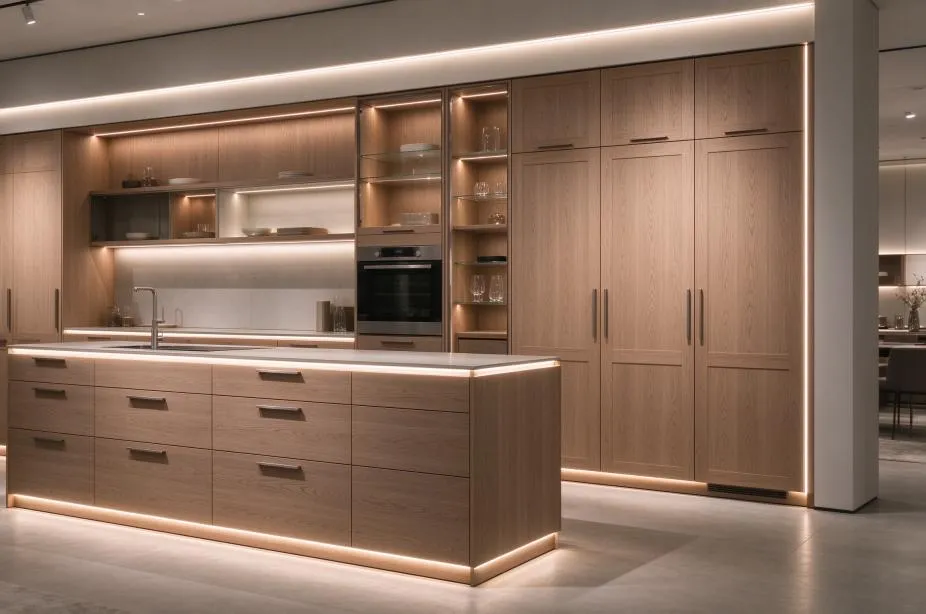
ARTCILUX flexible LED strip lighting integrated into modern kitchen cabinetry.
Why Is Consistent LED Color Temperature Important for Cabinet Lighting?
Color consistency is an important quality consideration in furniture lighting because multiple light sources are often installed within the same visual environment. Kitchen cabinets, wardrobe compartments, glass shelves, and display units may contain several LED fixtures that need to produce a uniform appearance.
For example, imagine a kitchen with LED strips installed beneath several adjacent wall cabinets. If one strip produces a slightly warmer white light while another appears cooler or more greenish, the difference may become noticeable across the countertop.
Similar problems can occur in:
Kitchen cabinets: Different color appearances between adjacent under-cabinet lights can make a continuous countertop lighting installation look inconsistent.
Wardrobes: Uneven light color across different compartments can affect the appearance of clothing, wood finishes, and interior surfaces.
Display cabinets: Color variations can influence how decorative objects, glassware, and displayed products appear.
Custom furniture projects: Lighting differences between furniture units produced at different times can reduce visual consistency in larger installations.
The key issue is that a nominal CCT value does not describe every aspect of LED color appearance. Two products carrying the same 4000K label may still produce slightly different visual results.
The CIE International Lighting Vocabulary defines correlated color temperature according to the relationship between a light source's chromaticity and the Planckian radiator. Therefore, CCT should be treated as one part of a broader lighting specification rather than the only quality indicator.
Understanding CCT, CRI, SDCM and Duv in LED Lighting
When evaluating LED lighting for furniture production, several technical parameters should be considered together. Each describes a different aspect of lighting quality.
| Parameter | What It Measures | Why It Matters |
|---|
| CCT | The apparent warmth or coolness of white light, measured in Kelvin. | Determines the intended lighting appearance. |
| CRI | How accurately a light source renders object colors compared with a reference source. | Important for wood, fabrics, countertops, and displayed products. |
| SDCM | A measure used to describe chromaticity variation around a reference color point. | Helps evaluate color consistency between LED products. |
| Duv | The distance of a light source's chromaticity from the Planckian locus. | Helps identify greenish or pinkish shifts in white light. |
What Does SDCM Mean in LED Lighting?
SDCM stands for Standard Deviation of Color Matching. It is commonly used to describe the chromaticity tolerance of LED light sources.
In general, a lower SDCM value indicates tighter color consistency. For example, LED products grouped within a three-step MacAdam ellipse have a smaller chromaticity variation than products with a wider tolerance.
For furniture manufacturers, tighter SDCM control is particularly valuable when multiple LED fixtures are installed side by side or when replacement products must visually match an existing installation.
ARTCILUX's cabinet LED strip light range highlights CRI 90+ and SDCM below 3 as part of its LED color quality and binning control approach. For individual projects, buyers should confirm the specific model's approved technical specifications and production tolerances.
Why Should Manufacturers Consider Duv?
Two LED strips can have the same nominal CCT but still look different because their chromaticity coordinates are not identical. Duv provides additional information about the direction of this difference.
This is particularly relevant when cabinet lighting is installed against neutral-colored surfaces, white countertops, or materials with subtle color variations.
The U.S. Department of Energy explains the relationship between CCT, Duv, chromaticity, and LED color consistency in its technical publication: LED Color Characteristics.
For measurement-based comparisons, chromaticity difference (Δu'v') can also provide a more complete assessment because it accounts for differences in both CCT and Duv.
How to Specify the Right CCT for Different Furniture Projects
Although color consistency is important, manufacturers must first establish an appropriate target color temperature for each furniture project. The selection should consider the intended application, furniture finish, surrounding lighting, and customer expectations.
| Color Temperature | Light Appearance | Potential Applications |
|---|
| 3000K | Warm white with a soft, inviting appearance. | Wooden wardrobes, residential cabinets, decorative shelves, and hospitality furniture. |
| 4000K | Neutral white with a balanced appearance. | Kitchen cabinets, modern wardrobes, work areas, and general furniture lighting. |
| 6000K | Cool white with a crisp, cooler appearance. | Selected modern display applications and projects requiring a cooler lighting effect. |
These are general application references rather than fixed rules. The same color temperature can produce different visual effects depending on the cabinet material, surface finish, diffuser, and surrounding environment.
For example, warm white lighting may complement natural wood finishes, while neutral white can be a practical choice for modern kitchens with white or gray surfaces. A cooler CCT should be evaluated carefully to ensure it matches the intended furniture design.
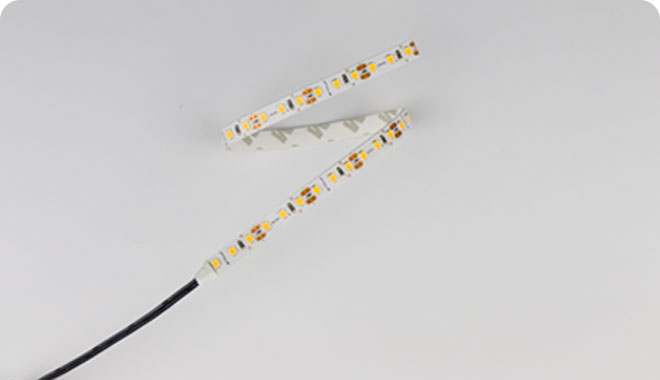
ARTCILUX's A2903 Flexible LED Strip Light provides a practical product example. Its published specifications list 12V versions in 3000K, 4000K, and 6000K, with an SMD2835 LED configuration, 8.5W/m power consumption, and a CRI above 90.
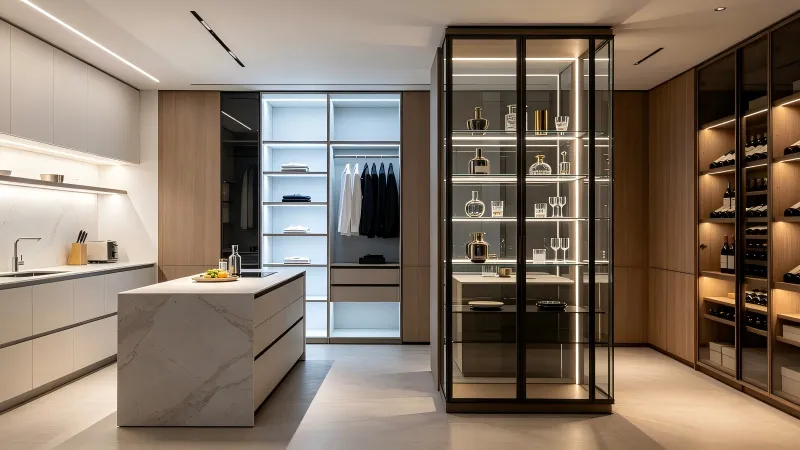
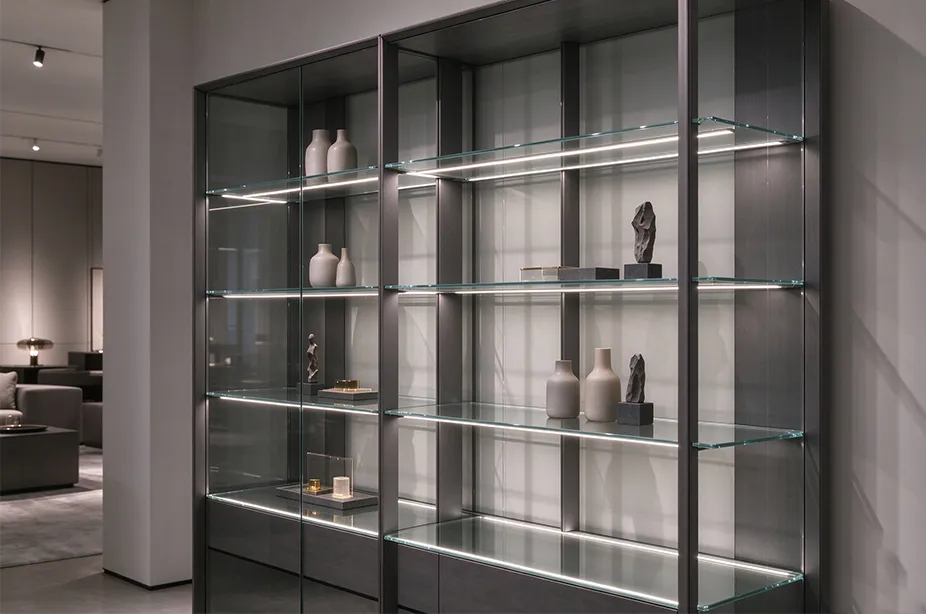
Integrated cabinet lighting across different furniture applications.
For larger furniture production programs, manufacturers should select a target CCT before mass production and apply the same approved specification to all corresponding lighting components. If a customer requests another color temperature, its availability and tolerance should be confirmed for the exact product model.
Fixed CCT vs. Tunable White: Which Lighting System Should You Choose?
Another important decision is whether to use fixed-color-temperature LED strips or tunable white lighting systems.
Fixed-CCT lighting uses a predetermined color temperature, such as 3000K or 4000K. It is generally easier to standardize for large furniture production programs because the lighting specification remains consistent throughout the project.
Tunable white lighting allows users to adjust the color temperature between warmer and cooler white settings. This can be useful for multifunctional spaces, premium furniture, and smart cabinet lighting applications.
However, tunable white systems require compatible LED strips, power supplies, controllers, and wiring arrangements. The warm and cool LED channels must be correctly matched with the control system. A controller designed only for brightness adjustment should not automatically be assumed to support CCT adjustment.
For projects requiring intelligent color temperature adjustment, the S1361.CCT.1H Tuya LED Light Controller is one of ARTCILUX's available control products. Its published specifications include 12V/24V operating voltage, 2.4GHz transmission, and 1000-level color temperature adjustment.
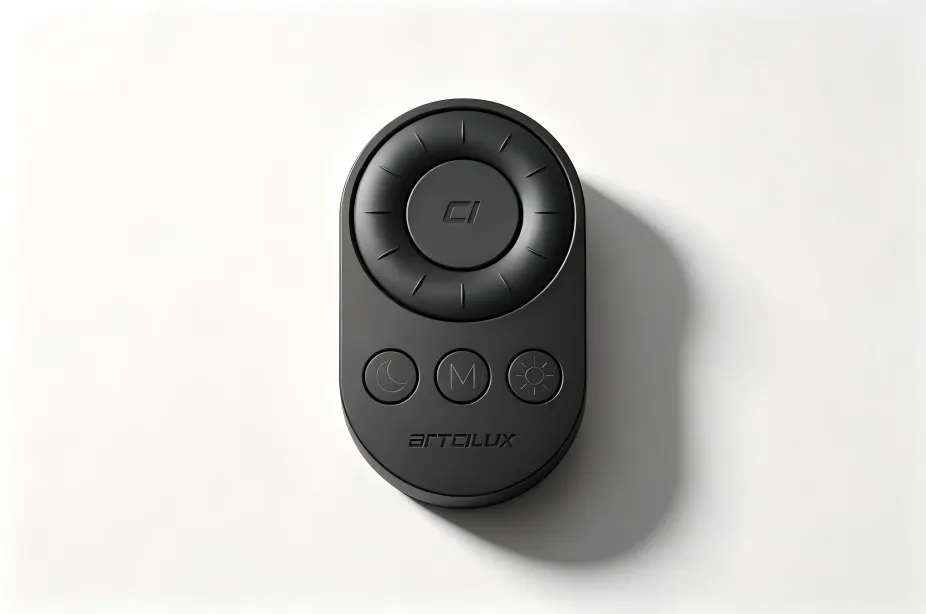
ARTCILUX S2102 wireless remote controller for brightness and color temperature adjustment.
The choice between fixed CCT and tunable white should depend on the project requirements, expected user experience, production complexity, and system compatibility. For standardized furniture lines, fixed CCT may be sufficient. For premium or multifunctional furniture, tunable white can provide additional flexibility.
How to Maintain LED Color Consistency from Sampling to Mass Production
Selecting a suitable LED specification is not enough if the same color quality cannot be maintained during manufacturing. Furniture brands and cabinet manufacturers should establish a repeatable quality control process before placing large orders.
Establish a Clear Lighting Specification
Define the target CCT, acceptable chromaticity tolerance, CRI requirement, and intended application before requesting samples. Avoid relying only on descriptions such as warm white or natural white.
Approve a Master Sample
Request a representative lighting sample and evaluate it with the actual cabinet material, diffuser, and installation profile. This provides a practical visual reference for future production batches.
Check LED Binning and Batch Consistency
LED manufacturers sort components according to characteristics such as chromaticity and luminous output. This process, known as LED binning, helps suppliers control variation between individual LEDs.
For large furniture projects, ask the lighting supplier to confirm whether the same LED binning requirements will be maintained across production batches. Request relevant technical or inspection records where available.
Evaluate Complete Lighting Assemblies
Color consistency should be checked at the finished fixture level, not only at the individual LED component level. Diffusers, aluminum profiles, optical materials, and installation positions can influence the final appearance.
Compare multiple finished fixtures side by side under consistent viewing conditions. This is particularly important for long LED strips and installations with several adjacent cabinet sections.
Maintain Production Records
Keep records of approved samples, LED batches, product specifications, and inspection results. If a component or material needs to be changed, the supplier should evaluate whether the change affects the lighting appearance before implementing it in mass production.
This approach helps reduce color mismatch, avoid unnecessary rework, and maintain consistent quality across repeated furniture orders.
What Should Be Included in a Cabinet LED Lighting Specification Sheet?
For furniture manufacturers and purchasing teams, a written lighting specification helps ensure that the supplier understands the required performance and quality expectations.
The following information should be included when sourcing LED lighting for a cabinet or furniture project:
| Specification Item | Information to Confirm |
|---|
| Target CCT | 3000K, 4000K, 6000K, or another approved value. |
| CCT Tolerance | Acceptable chromaticity deviation and SDCM requirements. |
| Color Rendering | Minimum CRI and additional color quality requirements when necessary. |
| LED Configuration | LED type, chip specification, PCB, diffuser, and optical structure. |
| Electrical Parameters | Operating voltage, power consumption, and compatible driver. |
| Control Method | On/off, dimming, CCT adjustment, or smart control compatibility. For wireless adjustment, a compatible S2102 rotary knob controller can be considered. |
| Quality Control | Master sample approval, batch traceability, and inspection requirements. |
For tunable white systems, the specification should also define the adjustable CCT range, channel configuration, controller compatibility, and whether brightness and color temperature can be controlled independently.
A detailed specification makes it easier to compare suppliers, evaluate samples, and maintain consistent lighting performance throughout the furniture production process.
FAQs About LED Color Consistency for Furniture Manufacturers
Does the Same CCT Guarantee the Same LED Light Appearance?
No. Two LED products with the same nominal CCT may still look different because of chromaticity variation, Duv, LED binning, and manufacturing tolerances. For consistent cabinet lighting, manufacturers should also evaluate SDCM and approve representative samples.
What Is a Good SDCM Value for Cabinet LED Lighting?
An SDCM value below 3 is a commonly used specification target for applications requiring relatively tight color consistency. However, the appropriate tolerance depends on the project, installation conditions, and visual requirements. Always confirm the actual specification with the supplier.
Can Different LED Batches Have Different Color Temperatures?
Yes. Manufacturing variations can result in differences in chromaticity between production batches. LED binning, batch control, approved samples, and production inspection help reduce these differences.
Can a Fixed-CCT LED Strip Be Converted into a Tunable White System?
Not simply by changing the controller. Tunable white lighting requires compatible LED configurations with independently controlled warm and cool channels, together with suitable drivers and controllers. Compatibility should be confirmed before selecting the complete system.
Should Furniture Manufacturers Request LED Lighting Samples Before Mass Production?
Yes. Sample approval allows manufacturers to evaluate color appearance, brightness, installation compatibility, and material interaction before committing to large production quantities. The approved sample should also be retained as a reference for future orders.
Conclusion
Consistent LED color is an important part of professional cabinet and furniture lighting quality. Choosing the correct nominal CCT is only the beginning. Manufacturers also need to consider CRI, SDCM, Duv, LED binning, control compatibility, and production batch management.
By establishing clear technical specifications, approving samples, and working with a supplier that understands integrated furniture lighting systems, cabinet manufacturers can reduce color inconsistencies and improve the overall quality of their finished products.
ARTCILUX provides cabinet LED strips, lighting controllers, power supplies, and integrated furniture lighting components for different furniture applications. For manufacturers and distributors developing new lighting projects, evaluating the complete lighting system and its technical compatibility is an important step toward reliable mass production.
ARTCILUX – Lighting up Masterpieces.