Choosing between recessed and surface-mounted cabinet lighting is an important decision for furniture manufacturers, cabinet makers, and interior design professionals. Both installation methods can provide effective illumination, but they differ in appearance, preparation requirements, installation complexity, and maintenance access.
Recessed lighting is integrated into a groove or prepared opening within the furniture, creating a low-profile appearance. Surface-mounted lighting is attached directly to the cabinet or furniture surface, making it a practical option when cutting or modifying the panel is not desirable.
For new furniture production, the mounting method should be considered during the design stage rather than after the cabinet has been manufactured. For existing furniture, installation space, panel construction, and access to wiring often determine which option is more practical.
This guide compares recessed and surface-mounted cabinet lighting, explains their installation requirements, and helps furniture manufacturers select suitable lighting solutions for different cabinet structures and project conditions. ARTCILUX offers a cabinet LED lighting range covering different fixture structures and mounting options for integrated furniture applications.

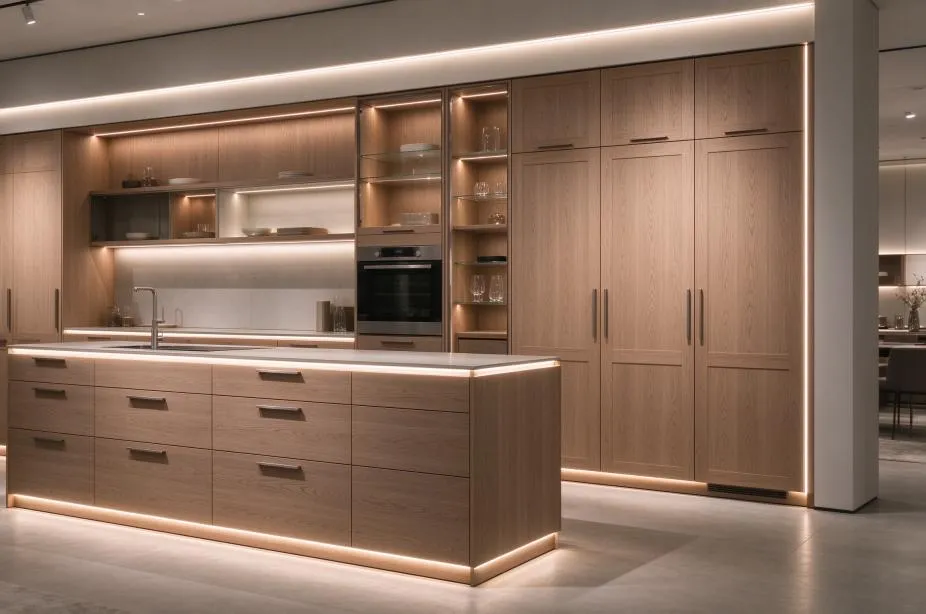
Integrated cabinet lighting in a modern kitchen illustrates how fixture placement can become part of furniture design.
What Is the Difference Between Recessed and Surface-Mounted Cabinet Lighting?
The main difference lies in how the lighting fixture is installed in relation to the furniture surface. This affects the visible profile, the amount of cabinet preparation required, and the available space for electrical connections.
Recessed Cabinet Lighting
Recessed cabinet lighting is installed inside a groove, channel, or prepared opening in the cabinet structure. The fixture sits within the furniture panel rather than projecting fully from its surface.
This method is commonly used for linear lighting beneath kitchen cabinets, inside wardrobes, along shelves, and within display furniture. By positioning the fixture within the cabinet structure, manufacturers can achieve a more integrated appearance.
However, recessed installation requires accurate preparation. The groove dimensions, installation depth, panel thickness, cable exit, and available mounting space must be confirmed before machining the furniture.
Surface-Mounted Cabinet Lighting
Surface-mounted cabinet lighting is attached directly to the exterior or interior surface of a furniture panel. It does not normally require a deep groove or recessed opening, although the selected model may still require specific mounting accessories or fixing points.
This approach is useful when furniture has already been manufactured, when the panel cannot be modified easily, or when the available installation depth is limited.
Surface-mounted fixtures may remain more visible than recessed alternatives, so their housing dimensions, finish, orientation, and cable routing should be considered as part of the overall furniture design.
Recessed vs. Surface-Mounted Cabinet Lighting: Key Differences
Although both installation methods can be used in kitchen cabinets, wardrobes, shelving, and display furniture, their practical advantages vary depending on the project.
| Comparison Factor | Recessed Lighting | Surface-Mounted Lighting |
|---|
| Installation | Installed in a prepared groove or opening. | Attached directly to the furniture surface. |
| Appearance | Low-profile and more integrated. | Fixture housing remains visible. |
| Cabinet Preparation | Requires accurate machining and dimensional planning. | Usually requires less modification to the panel. |
| Installation Space | Requires sufficient groove depth and internal clearance. | Requires adequate external mounting clearance. |
| Existing Furniture | May require additional cutting or structural modification. | Often more convenient for retrofit projects. |
| Maintenance | Access depends on the fixture design and installation details. | May be easier to reach when the mounting arrangement allows removal. |
| Best Application | New furniture with lighting planned during production. | Existing cabinets or projects with limited machining options. |
Neither method is universally better. The right choice depends on the cabinet structure, the desired visual effect, the available installation space, and whether the furniture is being manufactured or modified after delivery.
When Is Recessed Cabinet Lighting the Better Choice?
Recessed lighting is particularly suitable for furniture projects where a clean, integrated appearance is a priority and the cabinet structure can be prepared during manufacturing.
For kitchen manufacturers, for example, recessed linear lighting can be incorporated into the underside of wall cabinets to illuminate countertops while keeping the fixture relatively discreet.
It can also be used inside wardrobes, display cabinets, and shelving systems where visible lighting housings may interfere with the intended furniture design.
Advantages of Recessed Installation
Integrated appearance: The lighting fixture sits within the cabinet structure, supporting a clean and streamlined furniture design.
Protected positioning: Depending on the installation location, the recessed fixture can be less exposed to accidental contact or impact.
Consistent furniture design: Manufacturers can standardize groove dimensions and fixture positioning across repeated production units.
Flexible design integration: Lighting can be planned around shelves, cabinet edges, and other structural details.
What Should Be Prepared Before Installation?
Recessed lighting requires careful coordination between the furniture design team and the lighting supplier. Before production, manufacturers should confirm:
Required groove width, depth, and length.
Cabinet panel thickness and material construction.
Available space for the fixture housing and mounting components.
Wire exit positions and connection access.
Clearance for the LED driver and other electrical components.
How the fixture can be removed or serviced if necessary.
For example, ARTCILUX's A220K Recessed Strip Light is a product designed for recessed cabinet lighting applications. Its published specifications include a 1000 × 18 × 13 mm size, 12V DC operation, 10W power, and CRI above 90. The listed color temperature options are 3000K, 4000K, and 6000K.
These specifications provide a starting point for furniture design, but the actual groove and installation tolerances should always be confirmed against the approved product drawing.

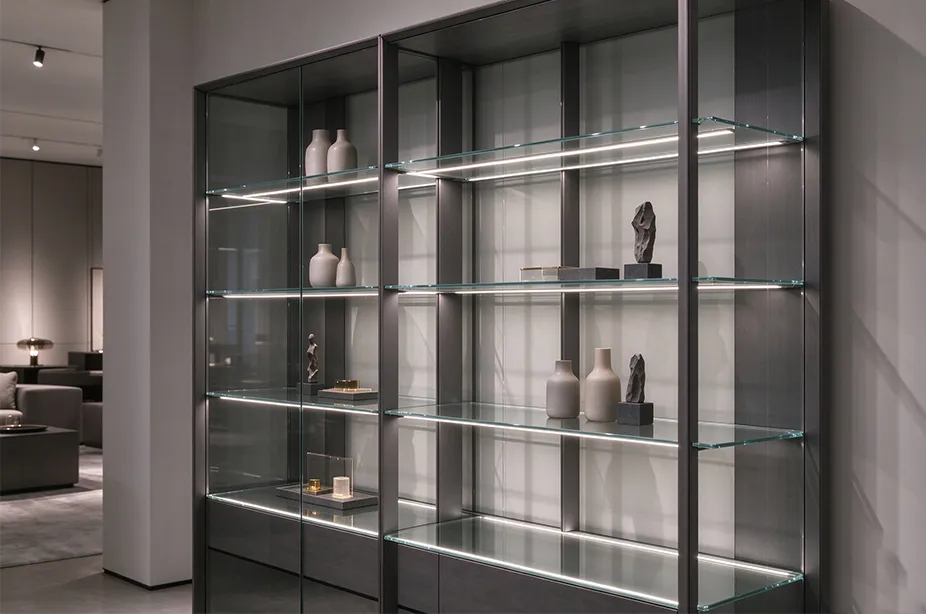
Integrated linear lighting in living room furniture demonstrates how lighting can become part of the original cabinet design.
When Is Surface-Mounted Cabinet Lighting More Practical?
Surface-mounted lighting is a practical option when manufacturers need to add illumination without making significant changes to the furniture structure.
It is especially useful for existing cabinets, renovation projects, display units, and furniture designs where cutting a groove is difficult or undesirable.
Advantages of Surface-Mounted Installation
Less structural modification: The installation usually does not require deep routing or a specially prepared recess.
Retrofit flexibility: Lighting can be added to many existing furniture structures after the main cabinet manufacturing process.
Simpler installation planning: Manufacturers can focus on mounting position, fixing method, and cable routing without designing a recessed channel.
Maintenance accessibility: Some surface-mounted designs allow easier access to the fixture and its connections.
What Should Manufacturers Consider?
Although surface-mounted lighting reduces the need for cabinet machining, the fixture should still be positioned carefully.
Check whether the fixture projects into a door, drawer, or shelf clearance area.
Confirm that the mounting surface is suitable for the selected fixing method.
Plan the cable route so that wiring does not interfere with normal cabinet use.
Consider the visible housing and finish when matching the fixture to the furniture.
Ensure that the fixture can be accessed for cleaning, replacement, and servicing.
ARTCILUX's A230A Surface-Mounted Triangle Light is one example of a surface-mounted furniture lighting product. Its published dimensions are 1000 × 23 × 6.4 mm, with 12V DC input, 6W/m power, and CRI above 90. Available color temperatures include 3000K, 4000K, and 6000K.
For manufacturers developing new cabinet designs, the visible profile and mounting position should be reviewed alongside the actual product dimensions before production begins.

Cabinet lighting can be coordinated with furniture surfaces and surrounding materials to achieve the intended appearance.
What Should Cabinet Manufacturers Check Before Installation?
Whether recessed or surface-mounted lighting is selected, several technical details should be reviewed before the furniture enters production or installation.
1. Cabinet Material and Panel Thickness
Different furniture materials have different machining and mounting requirements. MDF, plywood, particleboard, solid wood, and metal panels should not automatically be treated as having identical installation conditions.
For recessed fixtures, check the available material thickness and remaining structural section after machining. For surface-mounted fixtures, confirm that the panel can support the selected fixing arrangement.
2. Installation Dimensions and Tolerances
Do not rely only on the external dimensions of a lighting fixture when preparing cabinet openings. The required cutout size, installation depth, mounting accessories, and cable clearance may differ from the product's overall dimensions.
Manufacturers should request the technical drawing for the exact model and verify the dimensions with a physical sample before approving mass production.
3. Power Supply and Electrical Connections
Lighting fixtures, LED drivers, sensors, and controllers must be selected as a compatible system. Check the required operating voltage, total connected load, connector type, cable length, and control functions.
The U.S. Department of Energy and General Services Administration's LED Lighting and Controls Guidance also emphasizes the importance of matching drivers, lighting equipment, and control systems during project planning.
4. Maintenance and Replacement Access
Lighting should remain serviceable after the furniture has been installed. Consider how technicians can reach the fixture, disconnect the wiring, and replace components without damaging the cabinet structure.
This is particularly important for large kitchens, hotel furniture, and commercial display installations where maintenance may need to be performed repeatedly over the product's service life.
5. Product Safety and Installation Requirements
Check the manufacturer's installation instructions, rated electrical parameters, applicable certifications, and the requirements of the target market. The IEC 60598-1:2024 standard for luminaires covers general safety requirements and tests, including mechanical and electrical construction. Product compliance should be confirmed for the actual fixture and intended application.
How to Match the Mounting Method to Different Cabinet Applications
The most suitable installation method depends on how the furniture is designed, how the lighting will be used, and whether the project involves new manufacturing or an existing installation.
| Furniture Application | Possible Installation Choice | Key Considerations |
|---|
| Kitchen Cabinets | Recessed or surface-mounted | Countertop illumination, cabinet underside clearance, wiring access, and splash-zone requirements. |
| Wardrobes | Recessed or surface-mounted | Available groove depth, shelf structure, clothing clearance, and door movement. |
| Display Cabinets | Both methods | Fixture visibility, display arrangement, glass reflections, and maintenance access. |
| Living Room Furniture | Recessed or integrated | Concealed lighting, furniture appearance, and the desired indirect lighting effect. |
| Existing Furniture | Often surface-mounted | Limited machining options, mounting surface condition, and available power connections. |
Some lighting models are designed specifically for one installation method, while others support multiple mounting configurations.
For example, the ARTCILUX A112C Recessed / Surface-Mounted Spotlight supports both embedded and surface-mounted installation. Its published specifications include 12V operation, 2.5W power, and CRI above 90.
This type of product can provide additional flexibility when the same furniture design needs to accommodate different mounting conditions. However, the selected mounting accessories and installation dimensions must still be checked for the chosen configuration.
For furniture manufacturers and OEM buyers, the most reliable approach is to share the cabinet drawing, panel thickness, installation preference, required light output, and estimated quantity with the lighting supplier before finalizing the product selection.
FAQs About Recessed and Surface-Mounted Cabinet Lighting
Is Recessed Cabinet Lighting Better Than Surface-Mounted Lighting?
Neither option is universally better. Recessed lighting provides a more integrated appearance and is suitable for furniture designed with prepared grooves. Surface-mounted lighting is more practical when cabinet modification is limited or when adding lighting to existing furniture.
Can Surface-Mounted LED Lights Be Installed on Existing Cabinets?
Yes, many surface-mounted cabinet lights can be added to existing furniture, provided that the mounting surface, fixing method, electrical connections, and available clearance are suitable for the selected model.
Does Recessed Cabinet Lighting Require a Special Groove?
Most recessed fixtures require a prepared groove or opening that matches the product's installation dimensions. The required width, depth, and clearance vary by model, so manufacturers should follow the approved technical drawing before machining the cabinet.
Can One LED Fixture Support Both Recessed and Surface-Mounted Installation?
Some models support both methods, but this should be confirmed in the product specifications. For example, certain ARTCILUX spotlight models offer both recessed and surface-mounted configurations. The appropriate fixing components and installation dimensions must be verified before use.
What Should Furniture Manufacturers Provide When Requesting a Lighting Solution?
Useful information includes cabinet drawings, panel thickness, mounting position, desired lighting effect, operating voltage, control requirements, and estimated order quantity. Providing these details helps the supplier recommend a suitable fixture and compatible electrical components.
Choosing between recessed and surface-mounted cabinet lighting should begin with the furniture structure and project requirements rather than appearance alone. By evaluating installation dimensions, machining conditions, electrical compatibility, and future maintenance access, manufacturers can select a lighting solution that works reliably within the finished furniture.
ARTCILUX provides recessed strip lights, surface-mounted cabinet lights, spotlights, and integrated furniture lighting components for different cabinet and interior applications. Careful product selection and early coordination with the lighting supplier can help furniture manufacturers achieve a more consistent design and a smoother production process.
ARTCILUX – Lighting up Masterpieces.